Excavation Services in Corona, CA — What Homeowners Need to Know Before They Dig
Corona homeowners planning any kind of excavation — whether it's a water line, sewer lateral, driveway removal, grading project, or demolition — are often surprised by how different the experience is compared to neighboring cities.
Corona has its own soil profile, its own permit process through the City of Corona Development Services Department, and its own drainage and grading standards that affect how excavation work gets done. This guide covers everything Corona homeowners and contractors need to know before breaking ground.
About Corona, CA — The Circle City
Corona is a city in northwestern Riverside County, California, known historically as the "Circle City" due to the unique circular layout of Grand Boulevard, established when the city was founded in 1886 during the Southern California citrus boom. Once known as the "Lemon Capital of the World," Corona has evolved into one of the most populous and economically active cities in the Inland Empire, with a current population of approximately 163,000 residents spread across 39.2 square miles.
Corona sits at the junction of the 91 and 15 freeways, making it one of the most accessible cities in Riverside County. Its neighborhoods — from Downtown Corona and South Corona to Eagle Glen, Dos Lagos, Temescal Valley, and Sierra del Oro — span a wide range of elevations, terrain types, and soil conditions that directly affect how excavation work is planned and executed throughout the city.
Corona's Soil Profile — What's Under Your Yard
Understanding what's beneath your Corona property is one of the most important factors in planning any excavation project. According to soil and geotechnical data for the Corona area, the city sits on a mix of three primary soil types:
Clay — Found throughout lower-lying residential areas of Corona, particularly near drainage corridors. Clay soil expands when wet and contracts when dry — a cycle that affects trench stability, backfill compaction requirements, and long-term pipe alignment for water, sewer, and gas line installations.
Sandy loam — More common in elevated neighborhoods like Eagle Glen and parts of Sierra del Oro. Sandy loam is easier to excavate and drains well, but requires careful attention to trench wall stability in deeper digs.
Alluvial deposits — Corona's position near the Santa Ana River watershed means many areas sit on layered alluvial soil — a mix of sand, silt, gravel, and clay deposited by centuries of water flow. Alluvial soil can vary dramatically within a single property, which is why experienced excavators assess conditions before committing to a fixed approach.
What this means practically: two properties a few streets apart in Corona can have completely different soil conditions. A contractor who digs regularly in Corona knows to assess each site individually rather than applying a one-size-fits-all approach.
Corona's Terrain — How Elevation Affects Excavation
Corona's topography is one of the most varied in Riverside County. The city ranges from relatively flat valley floor neighborhoods near downtown to steeply sloped hillside communities in Temescal Valley, Eagle Glen, and the hills above Green River Road. This elevation range creates very different excavation challenges depending on where your property sits.
Flat valley neighborhoods — Easier equipment access, more predictable soil conditions, but higher likelihood of clay-heavy alluvial deposits and drainage challenges. Grading and drainage correction are common project types in these areas.
Hillside and elevated neighborhoods — Steeper grades, harder caliche and rocky substrate more likely at shallow depths, and drainage design becomes critical. The City of Corona has specific drainage and grading standards that govern how hillside and elevated properties must handle site drainage — these standards affect both grading scope and permit requirements.
Temescal Valley — One of Corona's fastest-growing residential areas, with significant ongoing development. Projects here often involve native hillside soil, rocky substrate, and access constraints from newer residential tract layouts.
City of Corona Permit Requirements for Excavation
The City of Corona Development Services Department oversees permits for excavation, grading, and construction work within city limits. Understanding what requires a permit before you start is essential — unpermitted excavation work in Corona can result in stop-work orders, fines, and required removal of completed work.
Here's a general breakdown of permit requirements for common excavation projects in Corona:
Water line trenching — New water service connections and replacements typically require permits and coordination with the relevant water district serving your area of Corona.
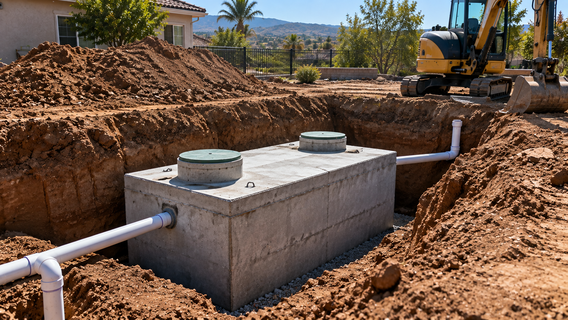
Sewer lateral installation and replacement — Sewer work in Corona requires permits from the City and must comply with City of Corona sewer standards. Work in the public right-of-way, including street cuts to connect to the main, requires additional encroachment permits.
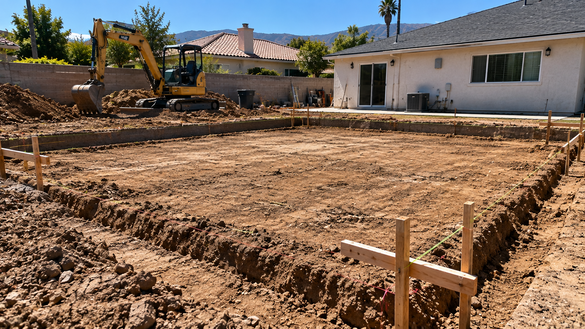
Grading and site preparation — The City of Corona has specific drainage and grading standards that govern residential grading projects. Projects moving significant volumes of soil typically require grading permits.
Demolition — Structure demolition in Corona requires a demolition permit from the City of Corona Building Division. The permit process includes utility disconnection confirmation before demolition can begin.
Driveway excavation — Work affecting the public right-of-way, curb cuts, or driveway approaches may require encroachment permits from the City of Corona Public Works Department.
The City of Corona Building Division is located at 400 S. Vicentia Ave and is open Monday through Thursday 7 AM to 6 PM. For most residential projects, your licensed contractor will advise on what permits are required and can coordinate the process.
Common Excavation Projects in Corona
Here are the most common excavation and trenching projects we handle for Corona homeowners and contractors:
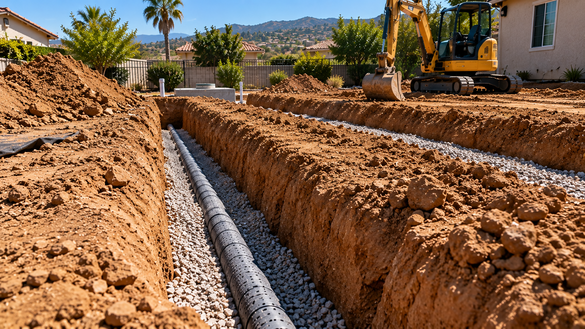
Water line trenching — Replacing aging water service lines is one of the most common residential excavation projects in Corona's older neighborhoods. Homes built in the 1970s and 1980s throughout South Corona and Downtown Corona are increasingly seeing original water service lines reaching end of life.
Sewer lateral replacement — Similarly, older sewer laterals in established Corona neighborhoods are a common excavation need. Root intrusion from mature trees — particularly in older neighborhoods with mature landscaping — is one of the leading causes of sewer lateral failure in Corona.
Driveway excavation and removal — Corona's older neighborhoods have significant concrete driveway replacement demand, while newer hillside neighborhoods in Temescal Valley and Eagle Glen frequently need RV pad and expanded parking excavation.
Grading and drainage correction — Improper drainage is one of the most common issues in both flat Corona neighborhoods (where clay soil sheds water toward foundations) and hillside neighborhoods (where grade and runoff control is critical). Drainage correction and grading projects are consistently high demand throughout the city.
Pool demolition — Corona has a significant pool-age issue — many pools installed in the 1980s and 1990s are now reaching the point where repair costs exceed replacement value, or homeowners simply want the yard space back. Pool demolition and fill is one of our most requested services in the Corona area.
ADU site preparation — Like the rest of California, Corona has seen a significant increase in ADU construction. ADU projects require grading, water line trenching, sewer lateral work, and gas line trenching — often all on the same project.
Caliche in Corona — The Hidden Excavation Challenge
One excavation challenge that catches many Corona homeowners off guard is caliche — a hardened layer of calcium carbonate that forms naturally in Southern California's arid climate. Caliche appears as a white or light-gray cemented layer anywhere from a few inches to several feet below the surface and can be extremely hard — sometimes requiring hydraulic breaking equipment before any digging can proceed.
Caliche is common throughout Riverside County and is particularly prevalent in:
- Hillside and elevated neighborhoods in Corona including Eagle Glen, Sierra del Oro, and Temescal Valley
- Areas with well-drained sandy loam soils where calcium carbonate accumulates near the surface
- Properties that have not been previously excavated to any significant depth
An experienced Corona excavation contractor will always assess for caliche potential during the site visit — and will have the equipment to break through it without derailing your project schedule.
How to Prepare for an Excavation Project in Corona
A few steps before your excavation crew arrives will save time and protect your property:
Confirm 811 utility marking is complete — California law requires 811 notification at least 48 hours before any excavation. Utility marking typically takes 2 to 3 business days. DigAlert handles Southern California marking and confirmation. Never let any crew dig in Corona without confirmed utility marking.
Know your water district — Corona is served by multiple water providers including the City of Corona's own utility and Elsinore Valley Municipal Water District depending on your specific neighborhood. Knowing which agency serves your property is important for permit coordination on water line work.
Clear equipment access — Backhoes and excavators need adequate access to the work zone. Confirm gate widths and remove vehicles from the path before the crew arrives.
Discuss drainage — For any grading or driveway project in Corona, talk with your contractor about how the finished grade will direct water away from your home. Given Corona's clay soil in many neighborhoods, drainage design is not optional.
Why Riverside Backhoe Service Works in Corona
We've been serving Corona homeowners and contractors for over 20 years as part of our broader Riverside County service area. We know Corona's soil variability, we're familiar with City of Corona permit requirements, and we've excavated in every neighborhood from Downtown Corona to Temescal Valley.
Every Corona project includes:
- Free on-site evaluation with soil condition assessment
- 811 utility marking coordination before any digging begins
- Equipment sized appropriately for residential access in all Corona neighborhoods
- Full debris removal and cleanup included
- Coordination with your plumber, paving contractor, or builder
- Proper backfill and compaction matched to actual soil conditions
Frequently Asked Questions — Excavation in Corona, CA
Who do I call for permits before excavation in Corona?
The City of Corona Development Services Department at 400 S. Vicentia Ave handles most residential excavation and construction permits. They are open Monday through Thursday 7 AM to 6 PM. For utility work, your contractor will also coordinate with the relevant water or sewer district serving your address.
Does Corona have its own grading and drainage standards?
Yes. The City of Corona has specific drainage and grading standards that govern how residential and commercial grading projects must handle site drainage. These standards affect the scope and design of grading projects throughout the city and are enforced through the City's Engineering Division.
Is caliche common in Corona?
Yes, particularly in elevated and hillside neighborhoods. Caliche hardpan is common enough in Riverside County that experienced excavators plan for it on every project, especially in areas with well-drained soils and on properties that haven't been previously excavated.
Which water district serves Corona?
Parts of Corona are served by the City of Corona's own water utility while other areas are served by Elsinore Valley Municipal Water District. Confirming your water provider before starting any water line project is important for permit coordination.
How deep does a sewer lateral need to be in Corona?
Sewer lateral depth in Corona varies based on the elevation of the city sewer main connection point and the distance from your structure. Your licensed plumber will specify the exact depth requirements based on the approved project design and City of Corona sewer standards.
What neighborhoods in Corona do you serve?
We serve all areas of Corona including Downtown Corona, South Corona, Eagle Glen, Dos Lagos, Green River, Sierra del Oro, Corona Hills, Brentridge, and Temescal Valley.
\
Planning an excavation project in Corona? Riverside Backhoe Service has been serving Corona homeowners and contractors for over 20 years. We know the soil, the terrain, and the City of Corona permit process — and we're ready to help your project move forward.
Call (951) 577-1959 for a free estimate and site evaluation.
You might also like