Excavating in Riverside's Clay Soil
If you've ever watched a backhoe dig in Riverside and noticed the soil coming up in thick, heavy chunks instead of loose dirt — that's clay. And if you're planning any kind of excavation project in Riverside, understanding what's beneath your yard before you dig is one of the most important things you can do. Soil conditions directly affect trench stability, timeline, cost, and backfill requirements. Here's what 20 years of digging in Riverside has taught us about the ground beneath this city.
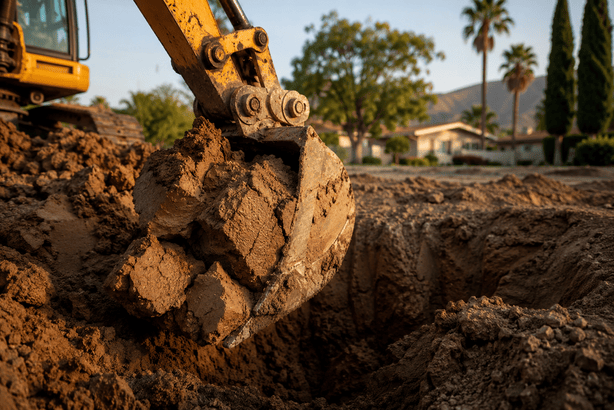
What Kind of Soil Does Riverside Have?
According to the City of Riverside General Plan and UC Riverside geological studies, Riverside sits on several distinct soil associations across its planning area. The primary soil types include:
- Cajalco-Temescal-Las Posas — found in hillside and elevated terrain areas
- Traver-Domino-Willows — lower lying areas with higher clay and silt content
- Monserate-Arlington-Exeter — moderately deep soils common in residential neighborhoods
- Hanford-Tujunga-Greenfield — sandy loam associations near river corridors
The Santa Ana River basin, which runs through Riverside County, stores groundwater primarily in clay, silt, and gravel alluvium. This means large portions of residential Riverside — particularly in lower-lying neighborhoods near the river corridor — sit on clay-heavy, alluvial soil that behaves very differently from simple sandy loam when excavated.
Additionally, the City of Riverside General Plan formally acknowledges that expansive soils are widely scattered throughout the planning area, found in both hillside areas and low-lying alluvial basins. These soils expand significantly when saturated with water and contract when they dry out — a cycle that has real consequences for any underground pipe or utility installation.
What Is Expansive Clay Soil and Why Does It Matter?
Expansive clay soil is exactly what it sounds like — soil with a high clay content that swells when wet and shrinks when it dries. In Riverside's climate, where winters bring rain and summers bring prolonged heat and drought, this expansion-contraction cycle happens every single year.
For homeowners this matters because:
Pipe alignment shifts over time — when the soil around a newly installed water line, sewer lateral, or gas line expands and contracts repeatedly, it can shift the pipe out of alignment. A pipe that passes inspection today can develop slope problems over several years if the backfill wasn't properly compacted and the soil behavior wasn't accounted for during installation.
Trench walls are less stable — clay soil in a wet state can lose cohesion and slump. A trench dug after winter rain behaves very differently than one dug in August. Trench wall stability must be assessed before any worker enters, and shoring requirements vary based on current soil moisture.
Backfill compaction is critical — because clay soil compacts differently than sandy soil, improper backfill in clay-heavy ground is one of the most common causes of surface settling after a trenching project. You've probably seen a driveway or sidewalk that developed a depression along the exact path of a previous utility trench — that's poor backfill compaction in expansive soil.
How Riverside's Soil Affects Different Types of Excavation
Water Line Trenching in Clay Soil
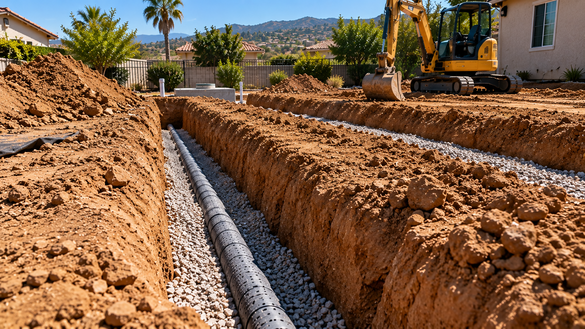
Water line trenches in Riverside's clay-heavy areas require careful attention to bedding — the material placed directly beneath the pipe before backfill. Clay soil doesn't provide the uniform, stable bedding that sandy soil does. In many cases, imported sand or gravel bedding is placed around the pipe before clay backfill begins, providing a stable cushion that prevents point loading and pipe damage as the surrounding soil moves seasonally.
Sewer Lateral Excavation in Clay Soil
Sewer laterals are slope-critical — even a small change in pipe alignment can cause chronic blockages or reverse flow. In expansive clay soil, getting the slope right at installation isn't enough on its own. The backfill compaction around a sewer lateral in clay soil must be executed in controlled lifts with proper moisture content to prevent future settling that changes the pipe slope over time.
Septic System Excavation in Clay Soil
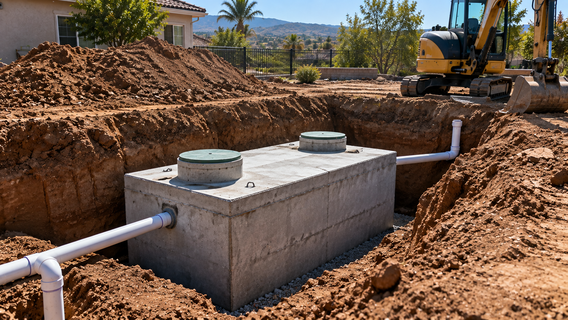
This is where clay soil creates the biggest headaches. Septic leach fields depend on soil permeability — the ability of the surrounding soil to absorb and filter effluent. Clay's low permeability is the primary reason many properties in certain parts of Riverside County fail percolation tests for septic system approval. If your property has high clay content, your septic system design may need to account for this through engineered leach field alternatives. This is something a perc test reveals before any excavation begins.
Demolition and Grading in Clay Soil
Grading projects in clay-heavy areas require additional attention to drainage design. Because clay sheds water rather than absorbing it, improperly graded clay soil directs runoff toward foundations, driveways, and structures. Riverside's hillside areas — where clay content is often highest — are particularly prone to erosion and runoff problems after grading if drainage swales and slopes aren't designed correctly.
Driveway Excavation in Clay Soil
A driveway base in clay-heavy soil requires deeper excavation and more robust base material than the same project in sandy soil. Clay's tendency to soften and shift when wet means a thin base over native clay will crack and heave within a few years. In many Riverside neighborhoods, proper driveway construction requires excavating the native clay deeper than standard depth and replacing it with compacted aggregate base before any concrete or asphalt is poured.
Riverside Neighborhoods Where Clay Soil Is Most Common
While soil conditions vary across individual properties, clay-heavy and expansive soils tend to be most prevalent in:
- Lower Riverside near the Santa Ana River corridor — alluvial clay and silt deposits from centuries of river sediment
- Arlington and Alessandro Heights areas — Monserate-Arlington soil associations with moderate clay content
- Hillside areas throughout Riverside — higher clay content in native hillside soils, plus expansive soil conditions documented in the General Plan
- Moreno Valley — similar alluvial basin conditions with clay and silt-heavy soil particularly in lower elevation areas
Properties in higher elevation areas on well-drained sandy loam associations generally have fewer clay-related excavation challenges — though rocky substrate and caliche deposits introduce their own complications in those areas.
What Does Clay Soil Mean for Excavation Cost and Timeline
Homeowners planning excavation projects in Riverside should understand that clay-heavy soil can affect both cost and schedule in a few specific ways:
Equipment selection — very dense or wet clay requires more powerful equipment and slower digging than loose sandy soil. In some cases, hardpan clay — particularly caliche, a hardened calcium carbonate layer common in Southern California — requires breaking before it can be excavated.
Disposal of excavated material — clay spoil is heavier than sandy soil per cubic yard, which affects hauling costs if excavated material needs to be removed from the site rather than used as backfill.
Bedding material — as noted above, water and sewer lines in clay soil often require imported sand or gravel bedding around the pipe, which adds material cost but is essential for long-term performance.
Backfill time — proper clay backfill requires compaction in controlled lifts rather than simply pushing all the excavated material back in at once. This adds time but prevents the settling and surface damage that results from rushing backfill in expansive soil.
The bottom line: in Riverside's clay soil, cutting corners on bedding or backfill compaction creates problems that show up months or years later and cost far more to fix than doing it right the first time.
How Riverside Backhoe Service Works With Riverside's Soil Conditions
After 20 years of excavating in Riverside, we've dug through every soil type this city has — river corridor silt, hillside clay, sandy loam, hardpan caliche, and everything in between. Here's what that experience means for your project:
- We assess soil conditions before providing any estimate — what we find in your yard directly affects our approach, equipment selection, and backfill plan
- We adjust bedding recommendations based on actual soil conditions at your site, not generic standards
- We compact backfill in proper lifts using appropriate equipment for the soil type
- We flag potential percolation issues for septic projects before excavation begins so you're not surprised by a failed perc test after spending money on site prep
- We've seen what happens when these steps are skipped — and we don't skip them
Frequently Asked Questions
How do I know if my Riverside property has expansive clay soil?
The most reliable way is a soil test, but there are signs: if your yard cracks during dry summer months and those cracks close up after rain, you likely have expansive clay. Doors and windows that stick in winter and loosen in summer are another indicator. For any significant excavation or construction project, a soils report from a geotechnical engineer provides definitive answers.
Does clay soil make excavation more expensive in Riverside?
Not dramatically in most cases, but it does add cost in specific areas — particularly bedding material for utility lines and additional time for proper backfill compaction. An honest contractor will tell you this upfront rather than surprising you with extra charges after digging begins.
What is caliche and is it common in Riverside?
Caliche is a hardened layer of calcium carbonate that forms naturally in Southern California's arid climate. It appears as a white or light gray layer anywhere from a few inches to several feet below the surface. It's common throughout Riverside County and can be extremely hard — requiring hydraulic breaking equipment before excavation can proceed. Not every property has it, but it's common enough that experienced Riverside excavators always plan for the possibility.
Can clay soil be used as backfill after trenching?
Native clay can be used as backfill in many situations, but it must be compacted in controlled lifts at appropriate moisture content. In some cases — particularly directly around water and sewer pipes — imported granular material is preferable. Your excavation contractor should discuss backfill strategy before any digging begins.
Does Riverside's clay soil affect septic system installation?
Yes significantly. Clay's low permeability can cause percolation test failures that prevent standard leach field approval. If you're planning a septic installation in a clay-heavy area of Riverside County, confirming perc test results before excavation begins is essential.
Planning an excavation project in Riverside?
Understanding your soil conditions before you dig is the difference between a project that performs long term and one that creates problems down the road.
Riverside Backhoe Service has been excavating in Riverside's clay soil for over 20 years — we know what's under your yard and how to work with it.
Call (951) 577-1959 for a free estimate and site evaluation.
You might also like