How Much Does Excavation Cost in Riverside, CA? (2026 Pricing Guide)
"How much will this cost?" is usually the first question homeowners and contractors ask before any excavation project — and it's also one of the hardest to answer with a single number, because excavation pricing depends on more variables than almost any other trade. This guide breaks down what actually drives cost, typical price ranges for common project types in Riverside County, and what can push a quote higher or lower.
What Determines Excavation Cost
Before getting into numbers, it helps to understand what a contractor is actually pricing when they quote an excavation job:
- Soil type and conditions — Riverside County's clay-heavy soil in many areas is harder to dig and compacts differently than sandy or loamy soil, which affects both time and equipment wear.
- Access to the site — A backyard reachable only through a narrow side gate takes longer and may require smaller equipment than an open lot with driveway access.
- Depth and volume — A shallow trench for irrigation lines costs far less than a deep foundation excavation moving significant cubic yards of material.
- Utility locates and existing lines — Projects near existing utility lines require more careful, often hand-assisted digging near marked areas, which adds labor time.
- Disposal and hauling — Whether excavated material can stay on-site (used for backfill or grading) or has to be hauled away affects the total cost significantly.
- Permits and inspections — Some projects require permit fees and inspection scheduling, which isn't part of the excavation cost itself but affects your total project budget.
Typical Excavation Costs by Project Type
These are general ranges based on common residential and light-commercial projects in Riverside County. Every property is different, so treat these as a starting point for budgeting, not a firm quote.
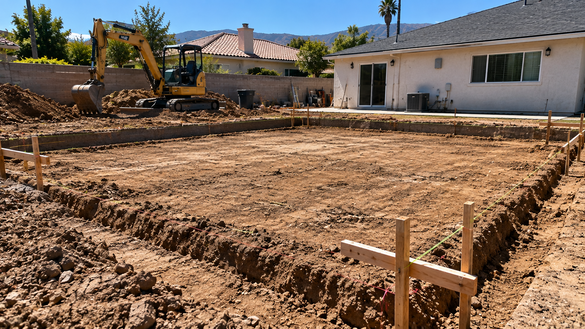
General site excavation / grading
Typically priced by the hour or by cubic yard depending on project size. Small residential grading jobs often run in the low thousands; larger lot grading or new-construction pad prep runs higher based on square footage and how much material needs to move.
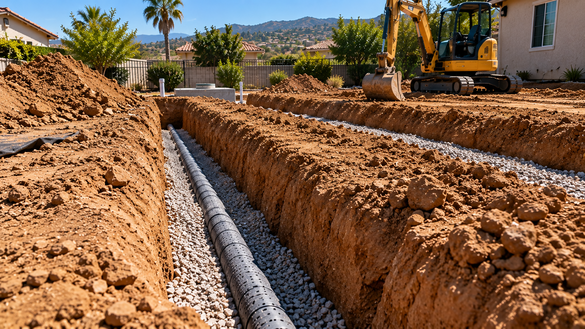
Utility trenching (water, electrical, irrigation)
Usually priced per linear foot, with cost depending on trench depth, soil conditions, and how close the work is to existing structures or landscaping.
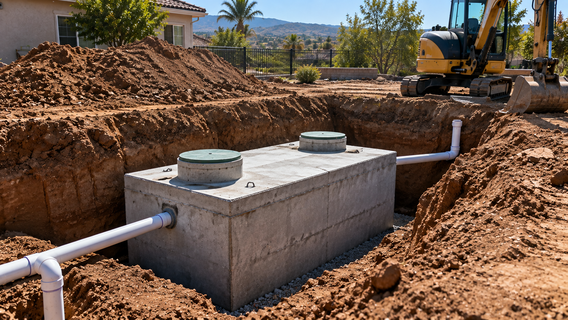
Septic tank excavation
Costs vary based on tank size, leach field length, and soil percolation requirements. Properties requiring a full system replacement cost more than a straightforward tank swap in an already-excavated area.
Sewer line excavation
Pricing depends heavily on depth, distance from the house to the main connection, and whether the old line needs full replacement or just a section repair. Collapsed or root-damaged lines that need full excavation cost more than clean trenching for a new lateral.
Pool excavation
One of the more expensive excavation categories due to depth, volume of material removed, and hauling costs — pricing depends heavily on pool size and soil conditions.
Land clearing
Priced based on lot size, vegetation density, and whether stump removal or grading is included afterward.
Demolition excavation (structures, slabs, pools)
Cost depends on the size of the structure, material type (concrete vs. wood-frame), and disposal requirements.
What Can Increase Your Excavation Cost
A few things commonly push a quote higher than a homeowner initially expects:
- Rock or hardpan soil that requires additional equipment time to break through
- Limited equipment access, requiring smaller machinery or more hand labor
- Unexpected utility conflicts discovered mid-project
- Hauling requirements when excavated material can't be reused on-site
- Permit delays that extend project timelines (not a direct cost, but affects scheduling)
How to Get an Accurate Quote
Because so much depends on site-specific conditions, the most reliable way to get accurate pricing is a free on-site estimate rather than a phone quote. A contractor walking your property can assess soil conditions, access, and scope in a way that a description over the phone can't fully capture.
Frequently Asked Questions
Is excavation priced by the hour or by the job?
It depends on the project. Smaller or open-ended jobs are often priced hourly, while defined-scope projects like trenching or septic excavation are more commonly quoted as a flat project price based on linear footage or cubic yardage.
Does soil type really make a big difference in cost?
Yes. Clay-heavy or rocky soil takes longer to excavate than loose or sandy soil, which directly affects labor time and, in turn, cost.
Is hauling away excavated dirt included in the price?
Not always — it depends on the contractor and project. Ask specifically whether hauling and disposal are included in your quote or billed separately.
Do permit fees count as part of the excavation cost?
No. Permit fees are typically separate from the contractor's excavation cost and are paid directly to the permitting agency.
How can I get the most accurate estimate for my project?
Schedule a free on-site evaluation. Site-specific factors like soil, access, and existing utilities have a bigger impact on final cost than general estimates can account for.
You might also like